Updated October 26, 20262026년 10월 26일 업데이트2026年10月26日更新2026年10月26日更新
A Face Looks Smaller When Volume Is in Its Place
Principles of facial volume in aging — a clinical perspective from more than a decade of aesthetic practice
Seong-Pil Jang, M.D. · Medical Director, Ellis Clinic (since 2014) · CEO, Veripuremedi Co., Ltd. — a physician who loves electronic engineering and keeps researching it
Summary
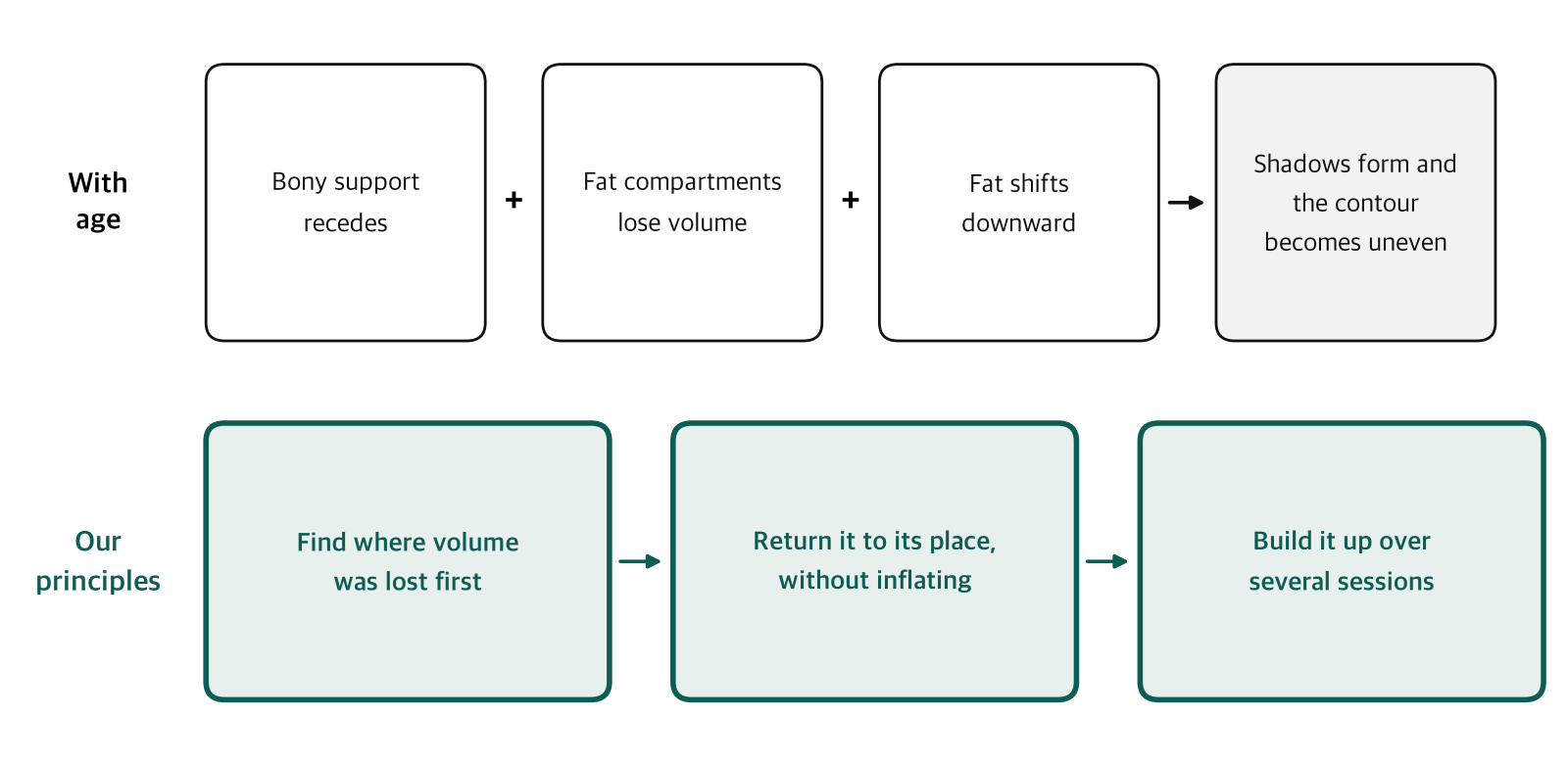
Bone size alone does not determine how small a face looks. Where the volume sits matters a great deal. With age, skin, fat, muscle, and bone all change together. Bony support recedes, fat compartments are redistributed downward, with volume loss in some compartments, and dermal collagen declines, so the outline of the cheekbones and jaw begins to show. In our practice, these faces look longer, more angular, and even larger.
So the principle we follow is simple. We do not inflate the face. We first identify where volume has been lost, return volume to those areas, and build it gradually over several sessions. This paper explains the anatomy behind that principle and how we assess a face.
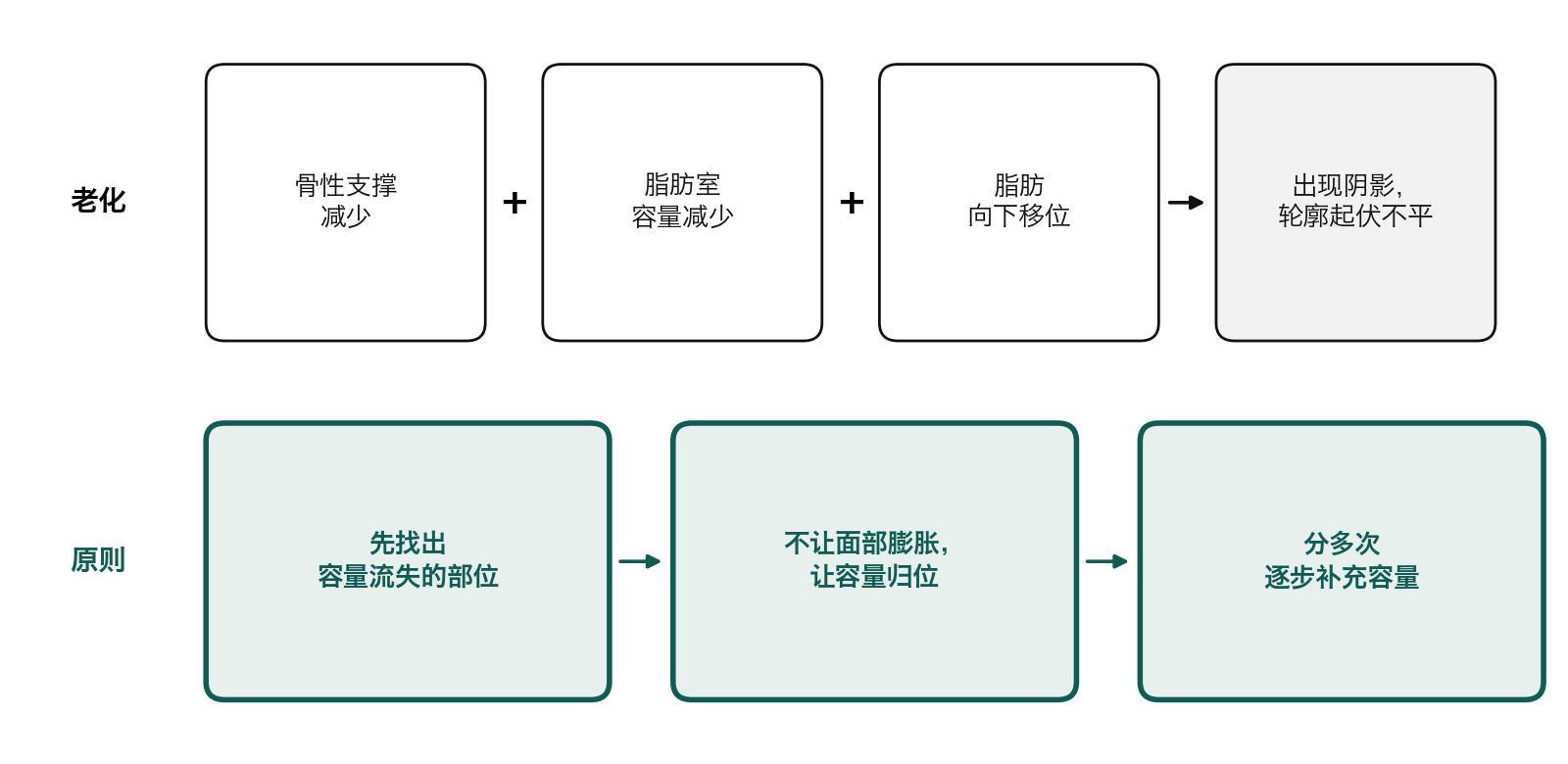
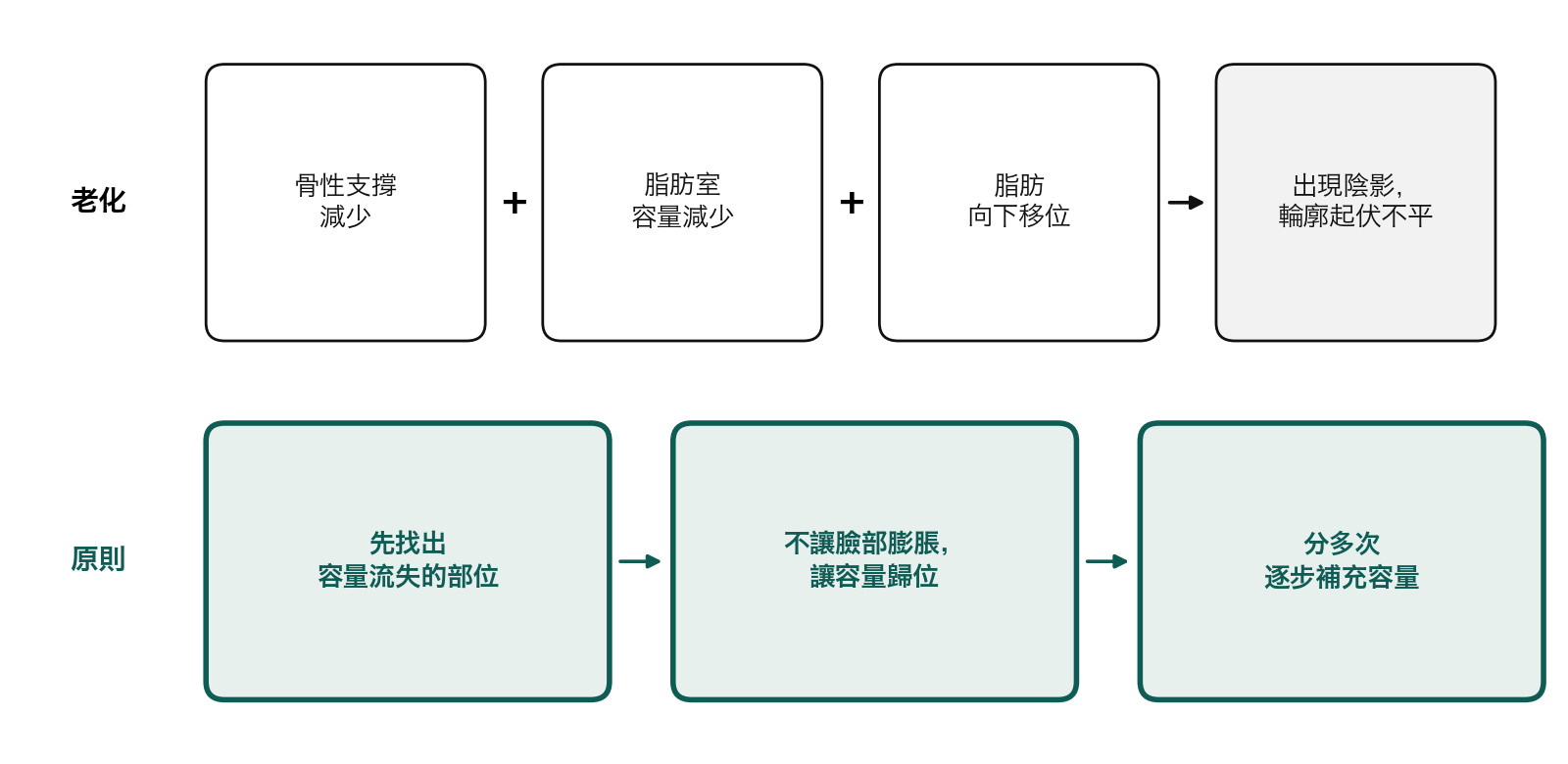
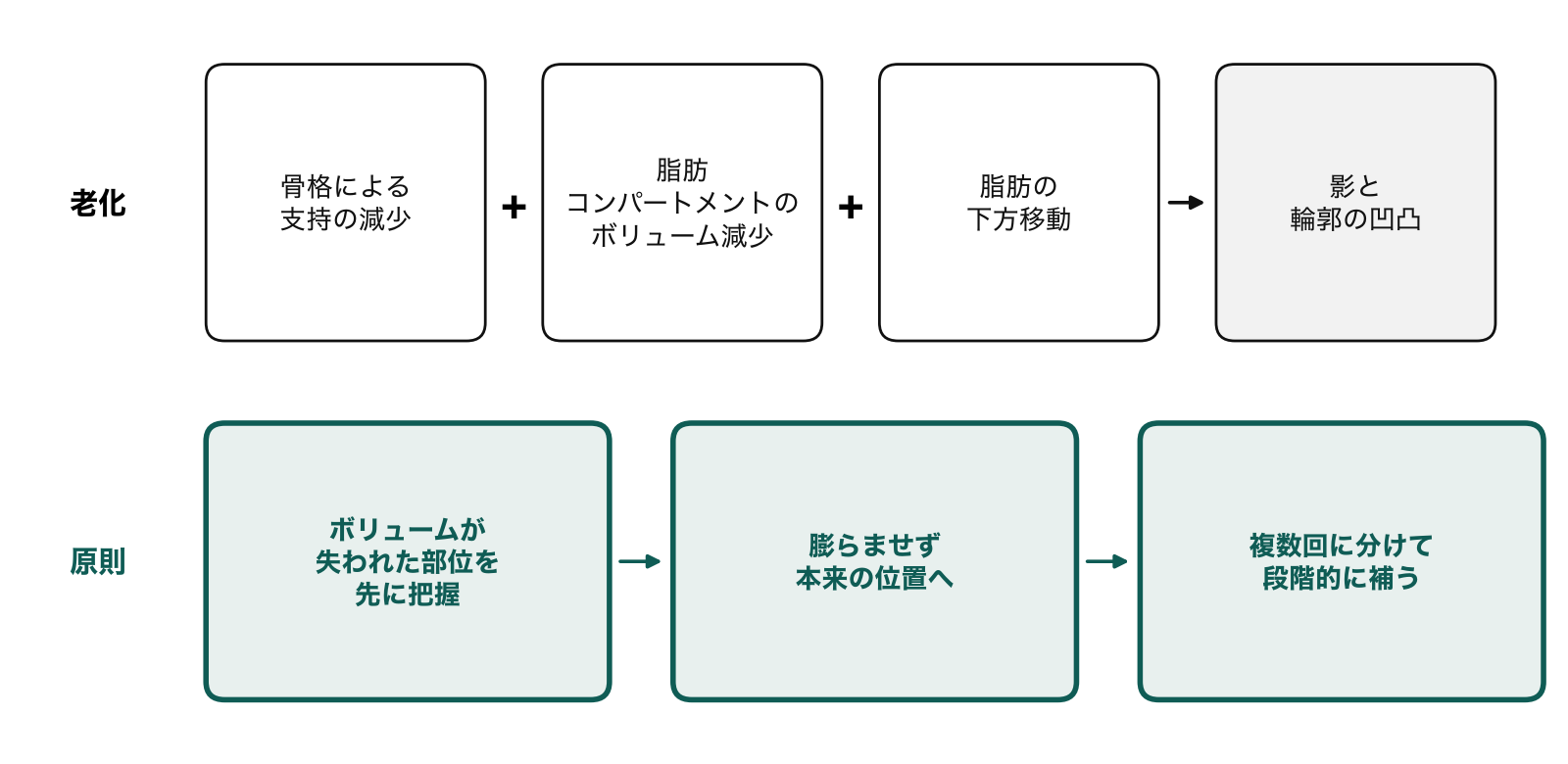
Figure 1. Top: how the face changes with age. Bottom: the principles we follow in restoring volume.
1. Aging Arrives in Stages
Aging does not arrive all at once. Age-related changes involve skin, fat, muscle, and bone [8]. In our practice, their pace and pattern vary from person to person. That is why two people of the same age can age very differently, and why we look at the face, not the age. We start by looking at what has been lost and what has shifted in this person's face.
2. The Triangle of Youth Inverts
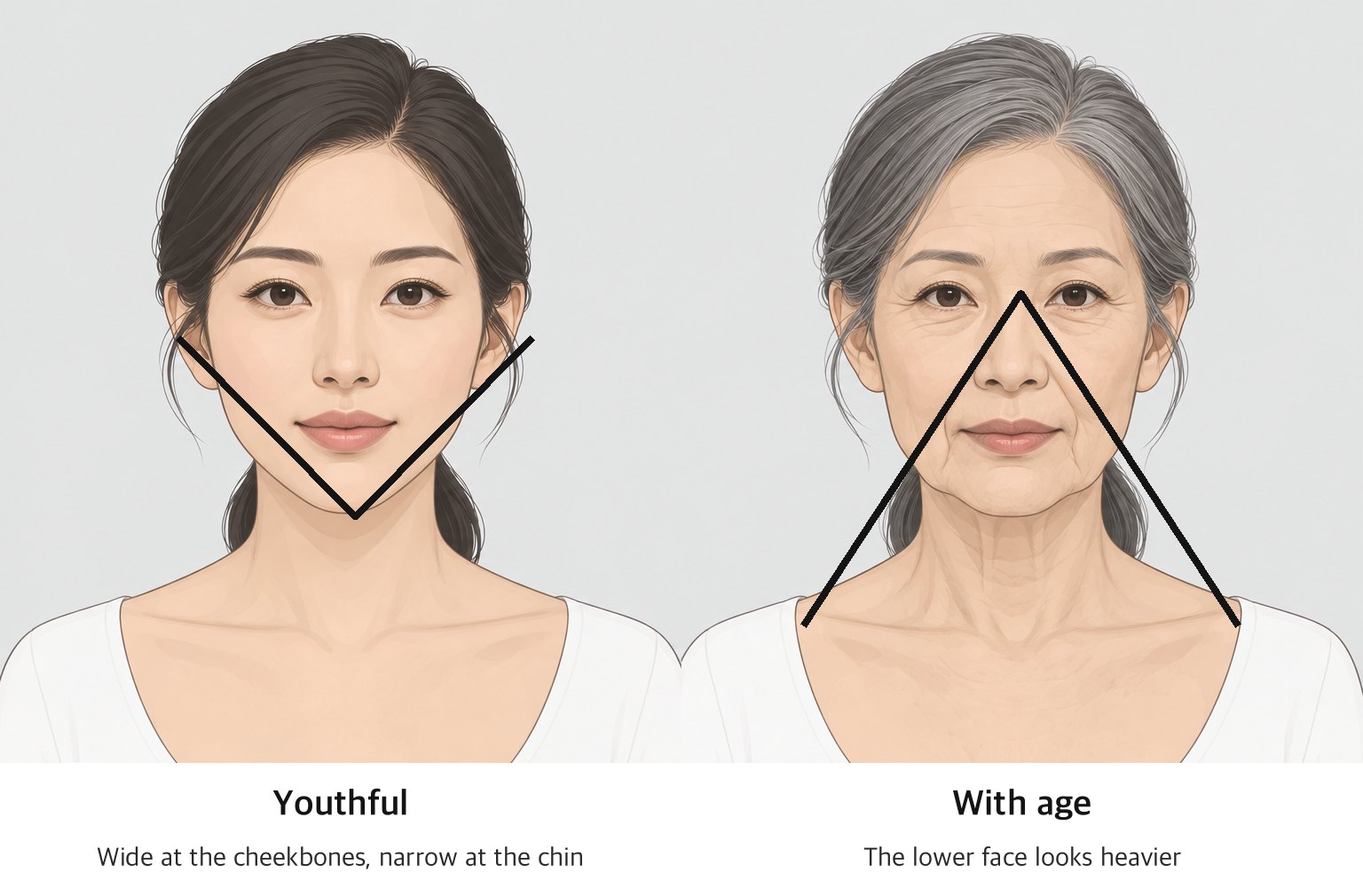
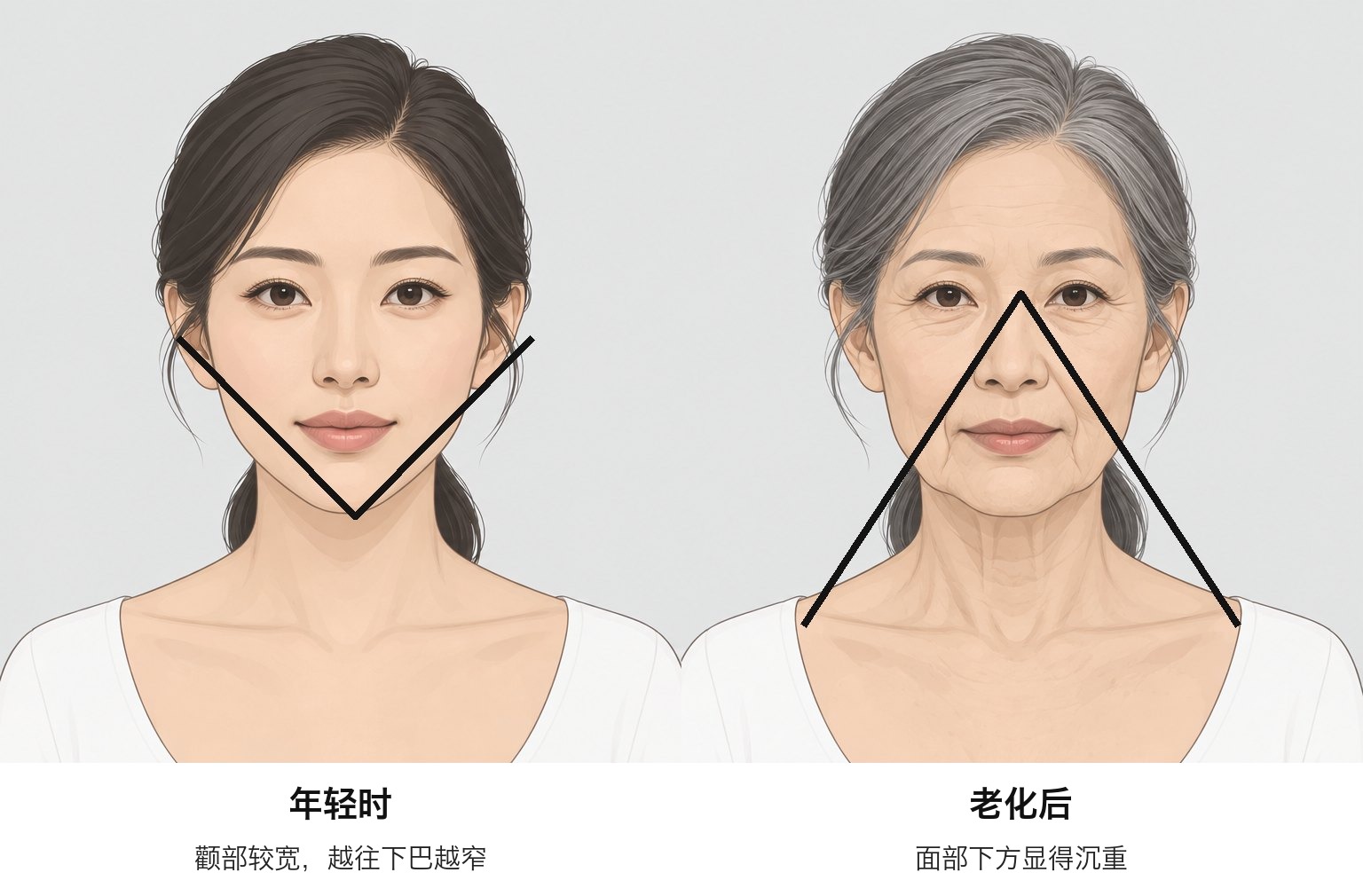
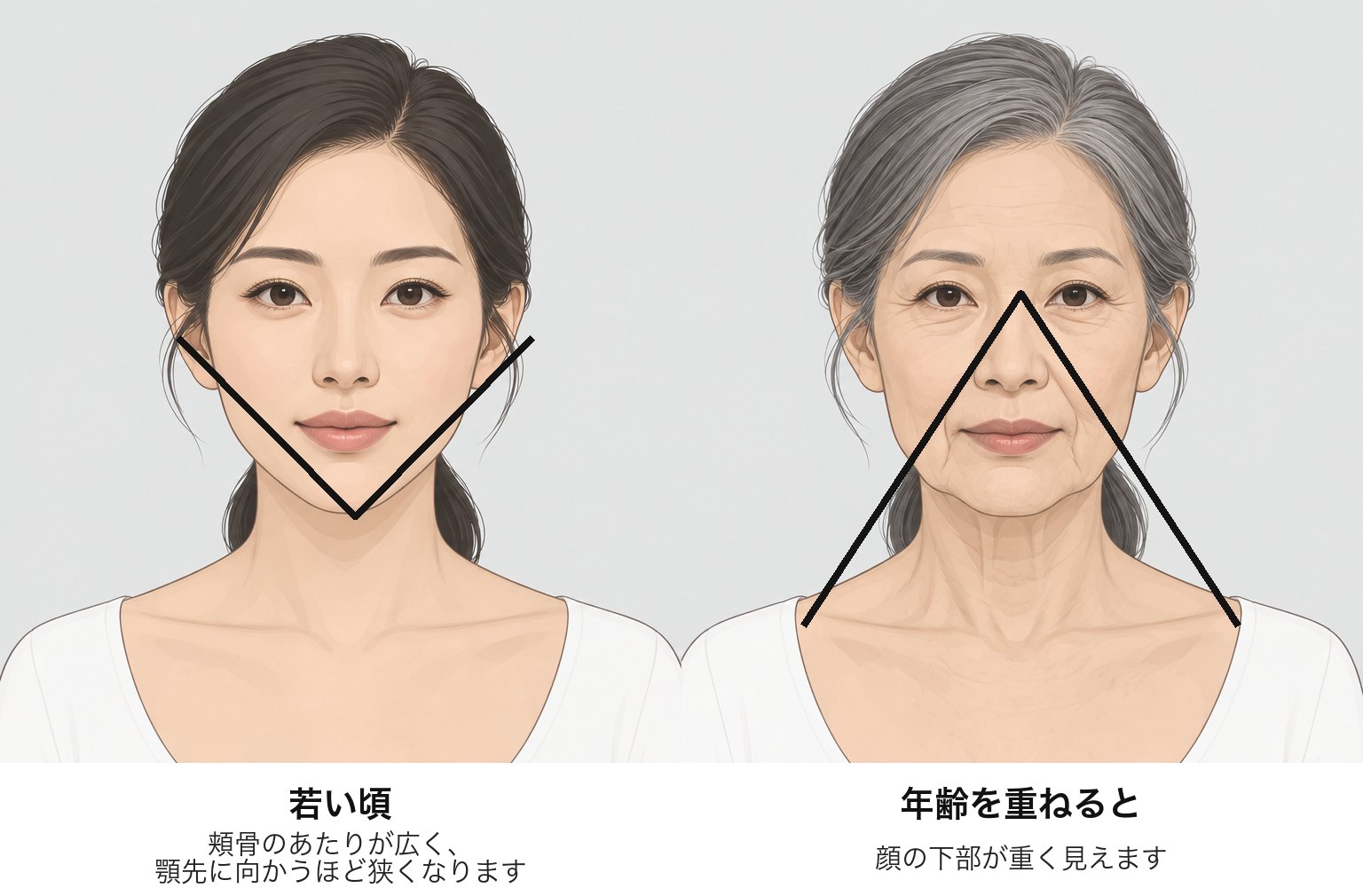
Figure 2. The triangle of youth (an explanatory model): the young face is drawn as an inverted triangle, wide at the cheekbones; with age, the wide end moves down [15].
The "triangle of youth," long used in aesthetic medicine, captures this change at a glance. In this model, a young face is drawn as an inverted triangle, wide at the cheekbones and narrowing toward the chin [15]. As the anterior cheek loses volume and weight settles lower, the wide end of the triangle moves down. The jawline blurs and the lower face looks heavy. We aim for a balanced distribution of facial volume, with the wide end of the triangle back at the top.
3. Every Layer Changes Together
Layer
With age
What it looks like
Bone
The maxilla and the piriform aperture region [4][5] and parts of the orbital rim [5] resorb; ramus height, mandibular body height, and mandibular body length measure smaller in older age groups [9]
Weaker support at the anterior cheek and beside the nose; a softer jawline
Fat
In the older group, midfacial fat compartments were positioned more inferiorly, and volume loss was reported in some compartments [3]
Anterior cheek hollows; the nasolabial fold can look more prominent [2]
Ligaments
Retaining ligaments separate spaces and compartments [6]; in our practice, tissue between them appears to descend
Jowling and contour breaks along the jawline
Skin
Dermal collagen declines with age [10]
Rougher texture, less recoil
3.1 Bone: The Foundation Shrinks
Facial bone does not shrink evenly with age; it recedes differently from region to region. The maxilla and the bone beside the piriform aperture resorb and recede [4][5], and so do the upper inner and lower outer parts of the orbital rim [5]. A CT study comparing age groups found smaller ramus height, mandibular body height, and mandibular body length in the older groups [9]. Reduced skeletal support beneath the skin and fat is also one reason the face looks hollow or saggy [5].
3.2 Fat: Positioned Lower, with Volume Loss in Some Compartments
Facial adipose tissue is organized into distinct anatomical compartments separated by septa [1]. A CT study comparing 12 nonfixed cadaveric heads across two age groups (54–75 and 75–104 years; six per group) found that the midfacial fat compartments in the older group were generally positioned more inferiorly and were thicker in their inferior portions. Volume loss was also reported in the deep medial cheek fat and the buccal extension of the buccal fat pad [3]. The authors of a related study link loss of the deep medial cheek fat to pseudoptosis of the cheek and a more prominent nasolabial fold [2].
Photographic comparisons of the same individuals over 10 to 50 years found relative vertical stability of the lid–cheek junction and other upper-midface landmarks [7]. Based on findings like these, we see aging not only as sagging but as volume being lost and moving out of place.
3.3 Ligaments and the Jawline: Where Tissue Is Held and Where It Falls
The retaining ligaments of the face separate its anatomical spaces and compartments [6]. In our practice, tissue held by a ligament tends to stay put, while tissue between ligaments is more likely to appear to descend. Jowling along the jawline is an example. The mandibular septum separates jowl fat from submandibular fat [11]. Changes on either side of that boundary, together with loss of skin elasticity, break the smooth line of the jaw.
3.4 Skin: Collagen Declines, and Thickness Varies by Area
Dermal collagen declines with age. Measurements of forearm skin showed an age-associated decline in collagen content [10], and reduced collagen synthesis in aged skin involves both changes in fibroblast function and reduced mechanical stimulation [12]. We see these changes as underlying skin that thins and loses its recoil.
Facial skin thickness also varies by area. In a cadaver study, total skin thickness was lowest at the upper medial eyelid and highest at the lower nasal sidewall [13]. The same principle has to be applied differently from one area to the next.
4. Why a Hollow Face Can Look Larger
This section reflects what we have observed over more than a decade of practice. When volume is gone, the outline of the cheekbones and jaw shows through. An uneven contour makes the face look angular, and hollowing at the front of the cheeks makes the midface look longer. So a face that has lost volume can look not only older but larger. In faces that look young and small, we consistently see a short midface and a smooth, continuous outline. In our practice, this has held across ethnicities.
5. The Principle: Return, Do Not Inflate
Start with the anterior cheek. When we assess midfacial proportions, we look first at anterior cheek fullness. What we aim for is a visually shorter midface.
Assess the outline of the face. The frame that runs from the hairline around the ear and along the jawline is the first thing to soften when elasticity drops. We assess temporal and lateral cheek hollowing together with that outline. The outline we aim for is a smooth, continuous contour with a gently tapered lower face, a soft V-line.
Know where to stop. Fill the forehead without making it bulge. Keep the lips full but not overdone. Leave the nose alone, and keep the natural shape of the eyes.
Build in stages. We prefer to build volume over several sessions rather than all at once, because inflating a face in one sitting tends to make it look heavy. Hyaluronic acid is highly hygroscopic and is degraded in the body by hyaluronidases and oxidative stress [14]. So we distinguish the initial volume from the changes in the tissue that follow, and we track them separately.
6. How to Identify Areas of Volume Loss
Assess volume in photographs. Lost volume shows up as shadow. Photographs taken under the same lighting, from the front, from each side, at 45 degrees on each side, with the chin raised, and from above, show hollows and uneven contours that a single front-facing photo misses. We take photographs in the same spot under the same light each time, so each session can be compared with the last.
Assess by palpation. Gently pinch and pull the skin at the hairline, cheek, and jawline. Where it is slow to spring back, elasticity has been lost. Palpation tells us about laxity. We identify areas of volume loss by weighing what we feel together with the shadows in the photographs.
Review the history. We give the patient's treatment and medical history the same weight. We start by identifying where volume is missing before deciding what to add.
7. The Person Before the Procedure
We look at the person before the procedure. We ask first about current skin condition, medical history, past treatments, and even the next few days' schedule. When in doubt, we do not treat that day. Specific criteria for who to treat and when to wait are covered in our education program.
8. Working with Devices: Stimulating Tissue and Restoring Volume
Energy-based devices such as HIFU and monopolar RF tighten tissue with heat and stimulate collagen production. Volume restoration fills in the volume that is missing. One stimulates tissue and the other restores volume, so neither replaces the other. We see volume restoration as an addition to a clinic's existing use of energy-based devices.
9. From the Clinic to the Home
Treatments are occasional; home care is daily. We think of in-clinic assessment and daily skin care as one continuous process. That is why we develop a clinic-only line and a home-care line together.
About This Paper
This paper discusses the principles of facial aging and volume distribution only. Clinical technique is taught directly in our invitation-only education program.
About Veripuremedi
Veripuremedi is a skincare and medical-device company born in aesthetic practice. We make LIZ VERIPURE PRO, a clinic-only line (eight solutions: five available now, three in development), and LIZ VERIPURE CARE, a seven-product home-care line, and we file our own patents on low-pain medical devices.
Rohrich RJ, Pessa JE. The fat compartments of the face: anatomy and clinical implications for cosmetic surgery. Plast Reconstr Surg. 2007;119(7):2219–2227.
Rohrich RJ, Pessa JE, Ristow B. The youthful cheek and the deep medial fat compartment. Plast Reconstr Surg. 2008;121(6):2107–2112.
Gierloff M, Stöhring C, Buder T, Gassling V, Açil Y, Wiltfang J. Aging changes of the midfacial fat compartments: a computed tomographic study. Plast Reconstr Surg. 2012;129(1):263–273.
Shaw RB Jr, Kahn DM. Aging of the midface bony elements: a three-dimensional computed tomographic study. Plast Reconstr Surg. 2007;119(2):675–681.
Mendelson B, Wong CH. Changes in the facial skeleton with aging: implications and clinical applications in facial rejuvenation. Aesthetic Plast Surg. 2012;36(4):753–760.
Alghoul M, Codner MA. Retaining ligaments of the face: review of anatomy and clinical applications. Aesthet Surg J. 2013;33(6):769–782.
Lambros V. Observations on periorbital and midface aging. Plast Reconstr Surg. 2007;120(5):1367–1376.
Fitzgerald R, Graivier MH, Kane M, et al. Update on facial aging. Aesthet Surg J. 2010;30(Suppl):11S–24S.
Shaw RB Jr, Katzel EB, Koltz PF, et al. Aging of the mandible and its aesthetic implications. Plast Reconstr Surg. 2010;125(1):332–342.
Shuster S, Black MM, McVitie E. The influence of age and sex on skin thickness, skin collagen and density. Br J Dermatol. 1975;93(6):639–643.
Reece EM, Pessa JE, Rohrich RJ. The mandibular septum: anatomical observations of the jowls in aging — implications for facial rejuvenation. Plast Reconstr Surg. 2008;121(4):1414–1420.
Varani J, Dame MK, Rittie L, et al. Decreased collagen production in chronologically aged skin: roles of age-dependent alteration in fibroblast function and defective mechanical stimulation. Am J Pathol. 2006;168(6):1861–1868.
Chopra K, Calva D, Sosin M, et al. A comprehensive examination of topographic thickness of skin in the human face. Aesthet Surg J. 2015;35(8):1007–1013.
Fallacara A, Baldini E, Manfredini S, Vertuani S. Hyaluronic acid in the third millennium. Polymers (Basel). 2018;10(7):701.
Moradi A, Montes JR, Humphrey S, et al. A unified approach to facial contours and volume correction: the role of the cheek and the chin. Plast Reconstr Surg Glob Open. 2024;12(10):e6219.
Update history
Narrowed the summary and Chapter 3 statements on bone and fat to what the cited studies measured.
Clarified that the triangle of youth is an explanatory model, and added reference 15.
Added a Japanese version.
Added a Chinese version.
Updated the author line.
First published.
작아 보이는 얼굴은 볼륨이 있어야 할 곳에 있습니다
노화와 얼굴 볼륨의 원리 — 10년 넘는 미용 진료 경험에서 정리한 임상적 관점
장성필 · 엘리스의원 대표원장(2014년~) · (주)베리퓨어메디 대표이사 — 전자공학을 좋아하고 연구하는 의사
요약
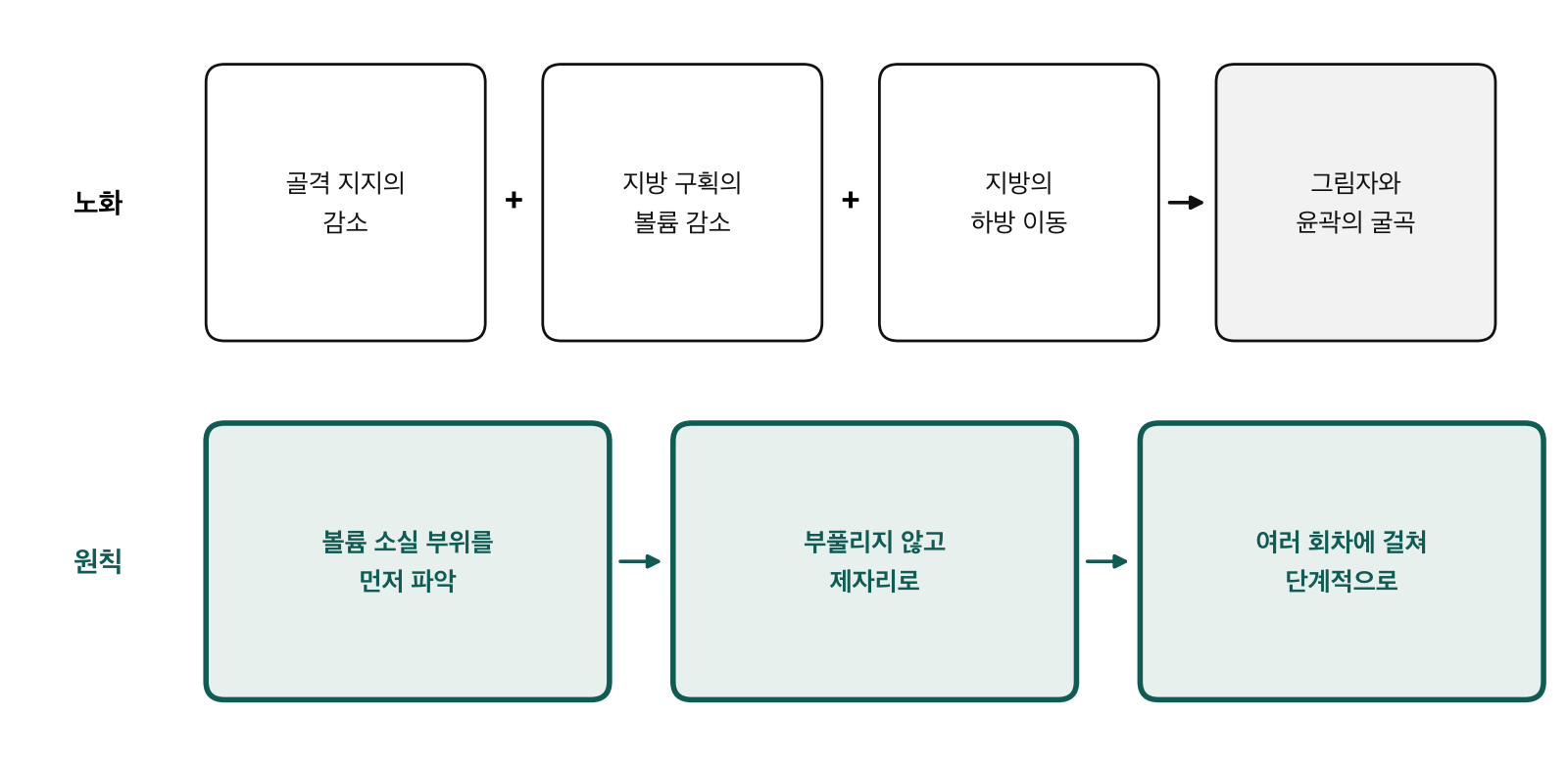
얼굴이 작아 보이는지는 골격의 크기만으로 결정되지 않습니다. 볼륨이 제 위치에 있는지가 크게 작용합니다. 노화가 진행되면 피부, 지방, 근육, 뼈가 함께 변합니다. 골격의 지지가 줄고, 지방 구획이 아래쪽으로 재분포하고 일부 구획의 볼륨이 감소하며, 진피 콜라겐이 감소하면서 광대와 턱의 골격 윤곽이 드러납니다. 저희 진료 경험에서 이러한 얼굴은 길고 각져 보이며, 오히려 더 커 보입니다.
따라서 저희가 따르는 원리는 단순합니다. 얼굴을 부풀리지 않습니다. 먼저 볼륨이 소실된 부위를 파악하고, 그 부위에 볼륨을 되돌리며, 한 번에 끝내지 않고 여러 회차에 걸쳐 단계적으로 쌓아 갑니다. 이 백서는 이 원리의 바탕이 되는 해부학과 저희가 얼굴을 평가하는 방법을 정리한 것입니다.
그림 1. 노화에 따른 얼굴의 변화(위)와 볼륨 복원의 원칙(아래).
1. 노화는 한 번에 오지 않습니다
노화는 어느 날 한꺼번에 오지 않습니다. 피부, 지방, 근육, 뼈가 함께 변하며[8], 저희 진료 경험상 그 속도와 양상은 사람마다 다릅니다. 같은 나이라도 얼굴이 다르게 늙는 이유입니다. 그래서 저희는 나이보다 얼굴을 봅니다. 지금 이 얼굴에서 무엇이 줄었고 무엇이 위치를 옮겼는지를 먼저 확인합니다.
2. 젊음의 삼각형이 뒤집힙니다
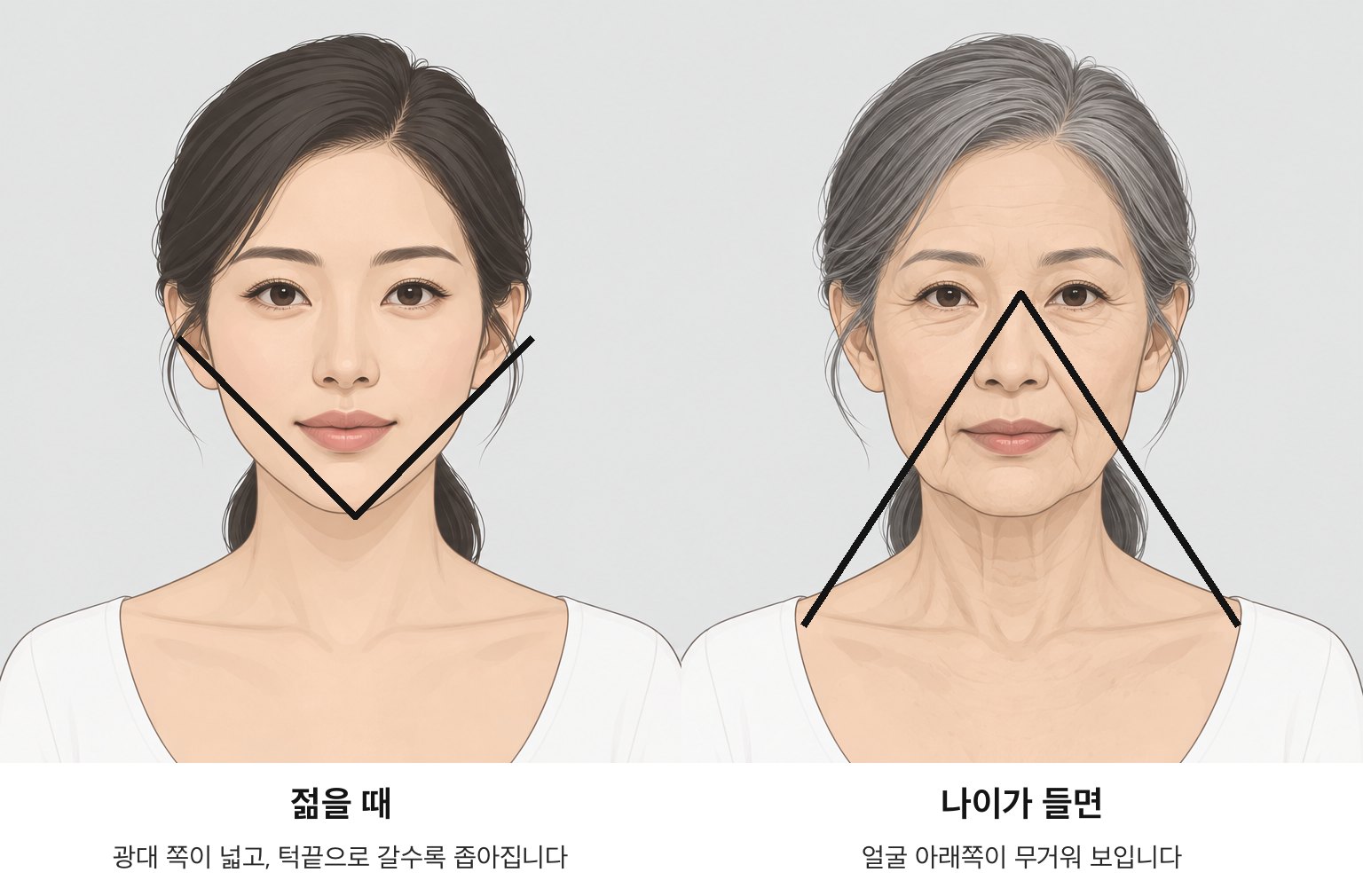
그림 2. 젊음의 삼각형(설명 모형). 이 모형에서 젊은 얼굴은 광대 부위가 넓은 역삼각형으로 그려지고, 노화가 진행되면 넓은 쪽이 아래로 이동합니다[15].
미용의학에서 오래 쓰여 온 「젊음의 삼각형(triangle of youth)」은 이 변화를 한눈에 보여 줍니다. 이 모형에서 젊은 얼굴은 광대 부위가 넓고 턱끝으로 갈수록 좁아지는 역삼각형으로 그려집니다[15]. 노화로 앞뺨의 볼륨이 줄고 하안면에 무게가 실리면, 삼각형의 넓은 쪽이 아래로 이동합니다. 턱선은 흐려지고 하안면은 무거워 보입니다. 저희가 지향하는 것은 위아래 볼륨의 균형, 즉 삼각형의 넓은 쪽이 다시 위에 놓이는 얼굴입니다.
3. 모든 층이 함께 변합니다
층
노화에 따른 변화
얼굴에 나타나는 변화
뼈
상악골과 이상구 주변[4][5], 안와연 일부[5]가 흡수되고, 하악지·하악체의 높이와 하악체의 길이가 고령군에서 더 작게 측정되었다[9]
앞뺨과 코 옆의 지지가 약해지고 턱선이 흐려진다
지방
고령군에서 중안부 지방 구획이 아래쪽으로 치우쳐 있었고, 일부 구획은 볼륨 감소가 보고되었다[3]
앞뺨이 꺼지고 팔자주름(비순주름)이 두드러져 보일 수 있다[2]
인대
유지 인대가 해부학적 공간과 구획을 나눈다[6]. 저희 진료 경험상 인대 사이의 조직이 처져 보인다
턱선을 따라 처짐과 굴곡이 생긴다
피부
진피 콜라겐이 나이가 들수록 감소한다[10]
피부결이 거칠어지고 탄력이 떨어진다
3.1 뼈 — 골격의 지지가 줄어듭니다
안면골은 나이가 들면서 균일하게 줄지 않고 부위에 따라 다르게 흡수됩니다. 상악골과 이상구(비강으로 들어가는 뼈 입구) 주변의 뼈가 흡수되어 뒤로 물러나고[4][5], 안와연(눈 둘레의 뼈 테두리)도 상내측과 하외측(위안쪽과 아래바깥쪽)이 흡수됩니다[5]. 서로 다른 연령군의 CT를 비교한 연구에서는 연령이 높은 군에서 하악지와 하악체의 높이, 하악체의 길이가 더 작게 측정되었습니다[9]. 피부와 지방을 받치는 골격의 지지가 줄어드는 것도 얼굴이 꺼지거나 처져 보이는 한 요인입니다[5].
3.2 지방 — 아래로 치우치고, 일부는 줄어듭니다
얼굴의 지방은 한 덩어리가 아니라, 얇은 격막으로 나뉜 여러 해부학적 구획으로 이루어져 있습니다[1]. 고정하지 않은 시신 머리 12구를 두 연령군(54~75세·75~104세, 각 6구)으로 나눠 CT로 비교한 연구에서는, 고령군의 중안부 지방 구획이 전반적으로 더 아래에 있었고 구획 안에서도 아래쪽이 더 두꺼웠습니다. 심부 내측 뺨 지방과 협부 지방체의 협측 연장부에서는 볼륨 감소도 보고되었습니다[3]. 앞뺨을 받치는 심부 내측 뺨 지방 구획(deep medial cheek fat)이 줄면, 앞뺨이 실제보다 처져 보이고(가성 하수) 팔자주름이 더 두드러져 보일 수 있다는 해석도 제시되었습니다[2].
같은 사람의 사진을 10~50년 간격으로 비교한 연구에서는, 눈꺼풀–뺨 경계를 비롯한 중안부 상부 기준점의 높이가 비교적 유지되었습니다[7]. 이러한 소견을 바탕으로 저희는 노화를 「처짐」만이 아니라 「볼륨의 감소와 이동」으로 봅니다.
3.3 인대와 턱선 — 고정되는 부위와 처지는 부위
얼굴의 유지 인대(retaining ligament)는 해부학적 공간과 지방 구획의 경계를 이룹니다[6]. 저희 진료 경험상 인대가 고정하는 부위는 비교적 유지되고, 인대와 인대 사이가 처져 보이기 쉽습니다. 턱선을 따라 생기는 처짐(jowl)이 그 예입니다. 하악 격막(mandibular septum)은 턱선 위쪽의 지방(jowl fat)과 턱 아래 지방을 나누는 경계입니다[11]. 이 경계 위아래의 변화에 피부 탄력 저하가 겹치면, 턱선의 매끈한 선이 끊기고 굴곡이 생깁니다.
3.4 피부 — 콜라겐이 줄고, 부위마다 두께가 다릅니다
진피 콜라겐은 나이가 들수록 감소합니다. 아래팔 피부를 측정한 연구에서 나이가 많을수록 콜라겐 함량이 적었고[10], 노화 피부에서 콜라겐 합성이 줄어드는 데에는 섬유아세포 자체의 변화와 주변 콜라겐에서 받는 기계적 자극의 감소가 함께 관여합니다[12]. 저희는 이러한 변화가 피부가 얇아지고 탄력이 떨어지는 바탕이 된다고 봅니다.
얼굴 피부의 두께도 부위마다 다릅니다. 시신 연구에서 피부 전층 두께는 위눈꺼풀 안쪽이 가장 얇고, 코 옆면 아래쪽이 가장 두꺼웠습니다[13]. 같은 원리를 적용하더라도 부위에 따라 접근을 달리해야 하는 이유입니다.
4. 마른 얼굴이 오히려 커 보이는 이유
이 장은 저희가 10년 넘게 진료하며 관찰한 내용입니다. 볼륨이 빠진 얼굴에서는 광대와 턱뼈의 윤곽이 드러납니다. 윤곽선에 굴곡이 생기면 얼굴이 각져 보이고, 앞뺨이 꺼지면 중안부가 길어 보입니다. 그래서 볼륨이 빠진 얼굴은 나이 들어 보일 뿐 아니라 오히려 더 커 보이기도 합니다. 저희가 관찰한 젊고 작아 보이는 얼굴에는 짧은 중안부와 매끈하게 이어지는 윤곽이라는 공통점이 있었고, 이는 저희 진료에서 인종과 관계없이 같았습니다.
5. 원리 — 부풀리지 않고, 있어야 할 곳으로
앞뺨부터 봅니다. 중안부의 비율을 평가할 때 가장 먼저 보는 것은 앞뺨의 볼륨입니다. 저희가 지향하는 것은 짧아 보이는 중안부입니다.
얼굴의 외곽선을 봅니다. 헤어라인에서 귀 주변을 지나 턱선으로 이어지는 얼굴의 외곽선은 탄력이 떨어지면 가장 먼저 흐려지는 부위입니다. 관자놀이와 바깥쪽 뺨의 꺼짐도 이 외곽선과 함께 평가합니다. 저희가 지향하는 윤곽은 매끈하게 이어지는 부드러운 V라인입니다.
과하게 하지 않습니다. 이마는 채우되 둥글게 튀어나오지 않게, 입술은 도톰하되 과하지 않게 합니다. 코는 손대지 않으며, 동양적인 눈매도 그대로 둡니다.
여러 회차에 걸쳐 쌓아 갑니다. 저희는 한 번에 채우기보다 여러 회차에 나누어 쌓아 가는 방식을 택합니다. 한 번에 부풀리면 얼굴이 무거워 보이기 쉽기 때문입니다. 히알루론산은 물을 끌어당기는 성질(흡습성)이 강한 물질이며, 체내에서 히알루로니다제와 산화 스트레스로 분해됩니다[14]. 그래서 저희는 처음 생긴 부피와 이후 조직의 변화를 구분해 경과를 관찰합니다.
6. 볼륨이 빠진 부위를 찾는 법
사진으로 봅니다. 볼륨이 빠진 부위는 그림자로 드러납니다. 같은 조명에서 정면, 좌우 측면, 좌우 45도, 턱을 든 각도, 위에서 내려다본 각도를 함께 보면, 정면 사진 한 장으로는 보이지 않던 꺼짐과 윤곽의 굴곡이 드러납니다. 사진은 매번 같은 자리, 같은 조명에서 찍습니다. 그래야 회차마다 무엇이 달라졌는지 비교할 수 있습니다.
손으로 봅니다. 헤어라인, 볼, 턱선의 피부를 가볍게 집어 당겨 봅니다. 놓았을 때 늦게 돌아오는 곳이 탄력이 떨어진 부위입니다. 촉진으로는 피부의 탄력과 이완 정도를 확인하고, 볼륨이 빠진 부위는 촉진 소견과 사진의 그림자를 종합해 판단합니다.
이력을 봅니다. 지금까지 받아 온 시술 이력과 병력도 같은 비중으로 확인합니다. 무엇을 더할지보다 어디가 빠졌는지를 먼저 파악하는 것이 이 원리의 출발점입니다.
7. 시술보다 사람을 먼저
저희는 시술보다 사람을 먼저 봅니다. 현재 피부 상태와 병력, 지금까지 받은 시술, 앞으로 며칠간의 일정까지 먼저 확인합니다. 판단이 서지 않으면 그날은 시술하지 않습니다. 대상자 선정과 시술을 미루는 구체적인 기준은 교육 과정에서 다룹니다.
8. 에너지 장비와의 관계 — 자극과 공급
HIFU나 모노폴라 RF 같은 에너지 기반 장비는 열로 조직을 수축시키고 콜라겐 생성을 자극합니다. 볼륨 복원은 빠진 볼륨을 다시 채우는 일입니다. 한쪽은 자극이고 다른 한쪽은 공급이므로, 서로를 대신하지 않습니다. 저희는 볼륨 복원을, 장비를 사용하는 클리닉의 기존 진료에 더하는 단계로 봅니다.
9. 클리닉에서 홈케어까지
시술은 가끔이지만 홈케어는 매일입니다. 저희는 클리닉의 평가와 일상의 피부 관리를 하나의 흐름으로 봅니다. 그래서 클리닉 전용 라인과 홈케어 라인을 함께 개발합니다.
이 백서에 대하여
이 백서는 얼굴 노화와 볼륨 분포의 원리만 다룹니다. 실제 시술 방법은 초청제로 운영하는 교육 과정에서 직접 전해 드립니다.
베리퓨어메디 소개
(주)베리퓨어메디는 미용 진료 현장에서 출발한 스킨케어·의료기기 회사입니다. 클리닉 전용 라인 LIZ VERIPURE PRO(8종 중 현재 5종, 3종 준비 중)와 홈케어 라인 LIZ VERIPURE CARE(7종)를 개발하고, 저통증 의료기기 특허를 직접 출원해 왔습니다.
Rohrich RJ, Pessa JE. The fat compartments of the face: anatomy and clinical implications for cosmetic surgery. Plast Reconstr Surg. 2007;119(7):2219–2227.
Rohrich RJ, Pessa JE, Ristow B. The youthful cheek and the deep medial fat compartment. Plast Reconstr Surg. 2008;121(6):2107–2112.
Gierloff M, Stöhring C, Buder T, Gassling V, Açil Y, Wiltfang J. Aging changes of the midfacial fat compartments: a computed tomographic study. Plast Reconstr Surg. 2012;129(1):263–273.
Shaw RB Jr, Kahn DM. Aging of the midface bony elements: a three-dimensional computed tomographic study. Plast Reconstr Surg. 2007;119(2):675–681.
Mendelson B, Wong CH. Changes in the facial skeleton with aging: implications and clinical applications in facial rejuvenation. Aesthetic Plast Surg. 2012;36(4):753–760.
Alghoul M, Codner MA. Retaining ligaments of the face: review of anatomy and clinical applications. Aesthet Surg J. 2013;33(6):769–782.
Lambros V. Observations on periorbital and midface aging. Plast Reconstr Surg. 2007;120(5):1367–1376.
Fitzgerald R, Graivier MH, Kane M, et al. Update on facial aging. Aesthet Surg J. 2010;30(Suppl):11S–24S.
Shaw RB Jr, Katzel EB, Koltz PF, et al. Aging of the mandible and its aesthetic implications. Plast Reconstr Surg. 2010;125(1):332–342.
Shuster S, Black MM, McVitie E. The influence of age and sex on skin thickness, skin collagen and density. Br J Dermatol. 1975;93(6):639–643.
Reece EM, Pessa JE, Rohrich RJ. The mandibular septum: anatomical observations of the jowls in aging — implications for facial rejuvenation. Plast Reconstr Surg. 2008;121(4):1414–1420.
Varani J, Dame MK, Rittie L, et al. Decreased collagen production in chronologically aged skin: roles of age-dependent alteration in fibroblast function and defective mechanical stimulation. Am J Pathol. 2006;168(6):1861–1868.
Chopra K, Calva D, Sosin M, et al. A comprehensive examination of topographic thickness of skin in the human face. Aesthet Surg J. 2015;35(8):1007–1013.
Fallacara A, Baldini E, Manfredini S, Vertuani S. Hyaluronic acid in the third millennium. Polymers (Basel). 2018;10(7):701.
Moradi A, Montes JR, Humphrey S, et al. A unified approach to facial contours and volume correction: the role of the cheek and the chin. Plast Reconstr Surg Glob Open. 2024;12(10):e6219.
美容医学中沿用已久的“青春三角”(triangle of youth)概念,直观地呈现了这一变化。该模型将年轻面部描述为倒三角形,即颧部较宽,向颏部逐渐变窄[15]。随着老化,前颊部容量减少,下面部的分量加重,三角形较宽的一端便向下移动。下颌线变得模糊,下面部显得沉重。我们所追求的,是上下容量的平衡,也就是让面部三角形较宽的一端重新回到上方。
Rohrich RJ, Pessa JE. The fat compartments of the face: anatomy and clinical implications for cosmetic surgery. Plast Reconstr Surg. 2007;119(7):2219–2227.
Rohrich RJ, Pessa JE, Ristow B. The youthful cheek and the deep medial fat compartment. Plast Reconstr Surg. 2008;121(6):2107–2112.
Gierloff M, Stöhring C, Buder T, Gassling V, Açil Y, Wiltfang J. Aging changes of the midfacial fat compartments: a computed tomographic study. Plast Reconstr Surg. 2012;129(1):263–273.
Shaw RB Jr, Kahn DM. Aging of the midface bony elements: a three-dimensional computed tomographic study. Plast Reconstr Surg. 2007;119(2):675–681.
Mendelson B, Wong CH. Changes in the facial skeleton with aging: implications and clinical applications in facial rejuvenation. Aesthetic Plast Surg. 2012;36(4):753–760.
Alghoul M, Codner MA. Retaining ligaments of the face: review of anatomy and clinical applications. Aesthet Surg J. 2013;33(6):769–782.
Lambros V. Observations on periorbital and midface aging. Plast Reconstr Surg. 2007;120(5):1367–1376.
Fitzgerald R, Graivier MH, Kane M, et al. Update on facial aging. Aesthet Surg J. 2010;30(Suppl):11S–24S.
Shaw RB Jr, Katzel EB, Koltz PF, et al. Aging of the mandible and its aesthetic implications. Plast Reconstr Surg. 2010;125(1):332–342.
Shuster S, Black MM, McVitie E. The influence of age and sex on skin thickness, skin collagen and density. Br J Dermatol. 1975;93(6):639–643.
Reece EM, Pessa JE, Rohrich RJ. The mandibular septum: anatomical observations of the jowls in aging — implications for facial rejuvenation. Plast Reconstr Surg. 2008;121(4):1414–1420.
Varani J, Dame MK, Rittie L, et al. Decreased collagen production in chronologically aged skin: roles of age-dependent alteration in fibroblast function and defective mechanical stimulation. Am J Pathol. 2006;168(6):1861–1868.
Chopra K, Calva D, Sosin M, et al. A comprehensive examination of topographic thickness of skin in the human face. Aesthet Surg J. 2015;35(8):1007–1013.
Fallacara A, Baldini E, Manfredini S, Vertuani S. Hyaluronic acid in the third millennium. Polymers (Basel). 2018;10(7):701.
Moradi A, Montes JR, Humphrey S, et al. A unified approach to facial contours and volume correction: the role of the cheek and the chin. Plast Reconstr Surg Glob Open. 2024;12(10):e6219.
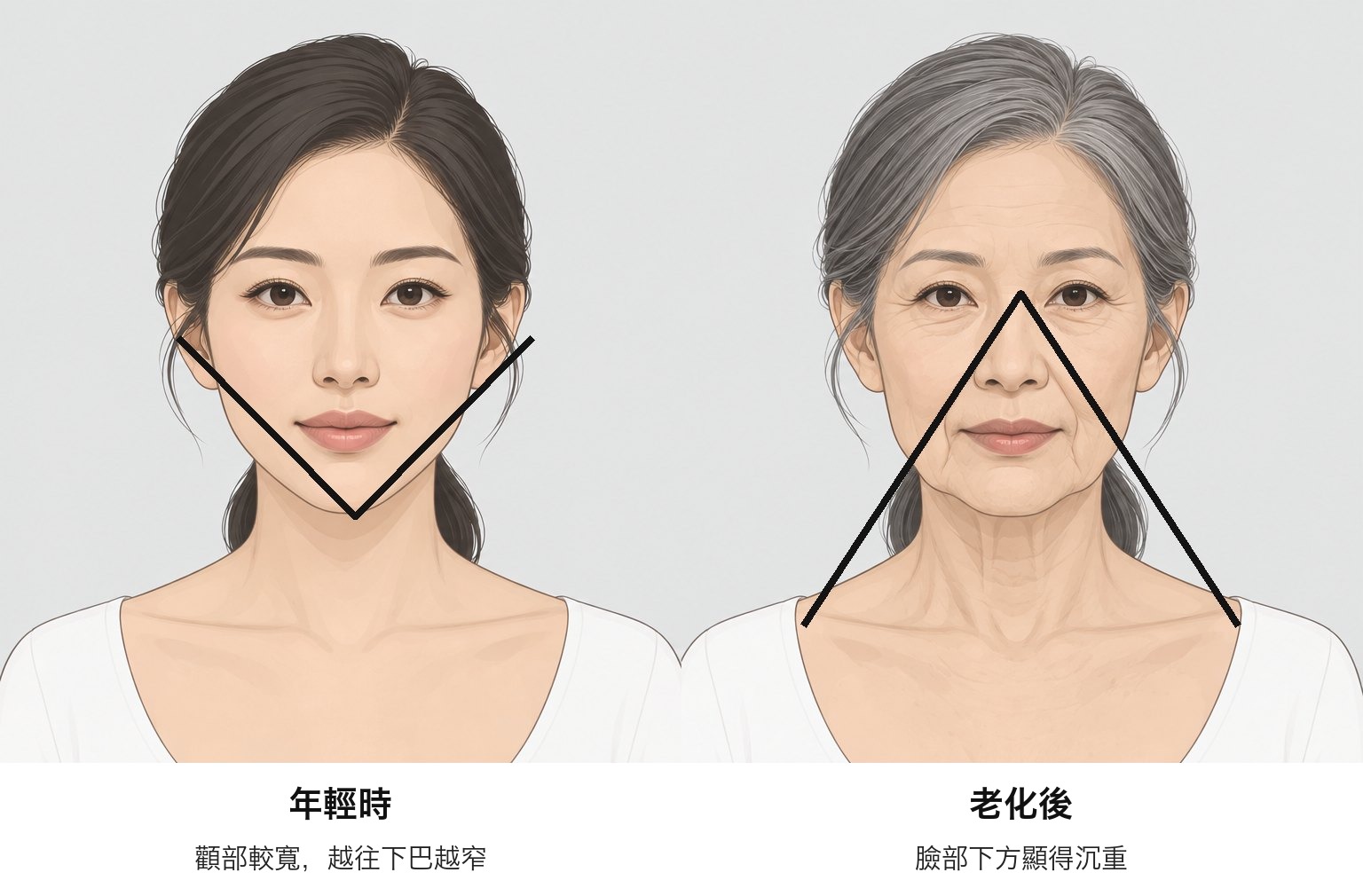
美容醫學中沿用已久的「青春三角」(triangle of youth)概念,直觀地呈現了這一變化。此模型將年輕臉部描述為倒三角形,即顴骨處較寬,往下巴方向逐漸變窄[15]。隨著老化,前頰部容量減少,下臉部的分量加重,三角形較寬的一端便向下移動。下顎線變得模糊,下臉部顯得沉重。我們所追求的,是上下容量的平衡,也就是讓臉部三角形較寬的一端重新回到上方。
Rohrich RJ, Pessa JE. The fat compartments of the face: anatomy and clinical implications for cosmetic surgery. Plast Reconstr Surg. 2007;119(7):2219–2227.
Rohrich RJ, Pessa JE, Ristow B. The youthful cheek and the deep medial fat compartment. Plast Reconstr Surg. 2008;121(6):2107–2112.
Gierloff M, Stöhring C, Buder T, Gassling V, Açil Y, Wiltfang J. Aging changes of the midfacial fat compartments: a computed tomographic study. Plast Reconstr Surg. 2012;129(1):263–273.
Shaw RB Jr, Kahn DM. Aging of the midface bony elements: a three-dimensional computed tomographic study. Plast Reconstr Surg. 2007;119(2):675–681.
Mendelson B, Wong CH. Changes in the facial skeleton with aging: implications and clinical applications in facial rejuvenation. Aesthetic Plast Surg. 2012;36(4):753–760.
Alghoul M, Codner MA. Retaining ligaments of the face: review of anatomy and clinical applications. Aesthet Surg J. 2013;33(6):769–782.
Lambros V. Observations on periorbital and midface aging. Plast Reconstr Surg. 2007;120(5):1367–1376.
Fitzgerald R, Graivier MH, Kane M, et al. Update on facial aging. Aesthet Surg J. 2010;30(Suppl):11S–24S.
Shaw RB Jr, Katzel EB, Koltz PF, et al. Aging of the mandible and its aesthetic implications. Plast Reconstr Surg. 2010;125(1):332–342.
Shuster S, Black MM, McVitie E. The influence of age and sex on skin thickness, skin collagen and density. Br J Dermatol. 1975;93(6):639–643.
Reece EM, Pessa JE, Rohrich RJ. The mandibular septum: anatomical observations of the jowls in aging — implications for facial rejuvenation. Plast Reconstr Surg. 2008;121(4):1414–1420.
Varani J, Dame MK, Rittie L, et al. Decreased collagen production in chronologically aged skin: roles of age-dependent alteration in fibroblast function and defective mechanical stimulation. Am J Pathol. 2006;168(6):1861–1868.
Chopra K, Calva D, Sosin M, et al. A comprehensive examination of topographic thickness of skin in the human face. Aesthet Surg J. 2015;35(8):1007–1013.
Fallacara A, Baldini E, Manfredini S, Vertuani S. Hyaluronic acid in the third millennium. Polymers (Basel). 2018;10(7):701.
Moradi A, Montes JR, Humphrey S, et al. A unified approach to facial contours and volume correction: the role of the cheek and the chin. Plast Reconstr Surg Glob Open. 2024;12(10):e6219.
美容医療で長く用いられてきた「若さの三角形(triangle of youth)」は、この変化を一目で示すものです。このモデルでは、若い顔は頬骨のあたりが広く、顎先に向かって狭くなる逆三角形として描かれます[15]。加齢により頬前面のボリュームが減り、下顔面に重みが出ると、三角形の幅の広い部分が下方へ移ります。フェイスラインがぼやけ、下顔面が重く見えるようになります。私たちが目指すのは、上下のボリュームが釣り合い、三角形の幅の広い部分が再び上にくる顔です。
Rohrich RJ, Pessa JE. The fat compartments of the face: anatomy and clinical implications for cosmetic surgery. Plast Reconstr Surg. 2007;119(7):2219–2227.
Rohrich RJ, Pessa JE, Ristow B. The youthful cheek and the deep medial fat compartment. Plast Reconstr Surg. 2008;121(6):2107–2112.
Gierloff M, Stöhring C, Buder T, Gassling V, Açil Y, Wiltfang J. Aging changes of the midfacial fat compartments: a computed tomographic study. Plast Reconstr Surg. 2012;129(1):263–273.
Shaw RB Jr, Kahn DM. Aging of the midface bony elements: a three-dimensional computed tomographic study. Plast Reconstr Surg. 2007;119(2):675–681.
Mendelson B, Wong CH. Changes in the facial skeleton with aging: implications and clinical applications in facial rejuvenation. Aesthetic Plast Surg. 2012;36(4):753–760.
Alghoul M, Codner MA. Retaining ligaments of the face: review of anatomy and clinical applications. Aesthet Surg J. 2013;33(6):769–782.
Lambros V. Observations on periorbital and midface aging. Plast Reconstr Surg. 2007;120(5):1367–1376.
Fitzgerald R, Graivier MH, Kane M, et al. Update on facial aging. Aesthet Surg J. 2010;30(Suppl):11S–24S.
Shaw RB Jr, Katzel EB, Koltz PF, et al. Aging of the mandible and its aesthetic implications. Plast Reconstr Surg. 2010;125(1):332–342.
Shuster S, Black MM, McVitie E. The influence of age and sex on skin thickness, skin collagen and density. Br J Dermatol. 1975;93(6):639–643.
Reece EM, Pessa JE, Rohrich RJ. The mandibular septum: anatomical observations of the jowls in aging — implications for facial rejuvenation. Plast Reconstr Surg. 2008;121(4):1414–1420.
Varani J, Dame MK, Rittie L, et al. Decreased collagen production in chronologically aged skin: roles of age-dependent alteration in fibroblast function and defective mechanical stimulation. Am J Pathol. 2006;168(6):1861–1868.
Chopra K, Calva D, Sosin M, et al. A comprehensive examination of topographic thickness of skin in the human face. Aesthet Surg J. 2015;35(8):1007–1013.
Fallacara A, Baldini E, Manfredini S, Vertuani S. Hyaluronic acid in the third millennium. Polymers (Basel). 2018;10(7):701.
Moradi A, Montes JR, Humphrey S, et al. A unified approach to facial contours and volume correction: the role of the cheek and the chin. Plast Reconstr Surg Glob Open. 2024;12(10):e6219.